
Slow Cooker Black Bean and Sweet Potato Stew Prep
Some winter weeks call for food that is warm, filling, cheap, and completely undemanding — and this slow cooker black bean sweet potato stew checks all four boxes without breaking a sweat. Black beans and sweet potatoes are two of the most affordable ingredients in any Canadian grocery store, and together they make a thick, smoky, satisfying stew that happens to be naturally vegan, high in fibre, and freezer-friendly for months.
This is also one of the simplest recipes in the whole winter slow cooker lineup. There is no meat to trim, no dairy to temper, no cheese to grate. Everything goes into the cooker at once, and eight hours later you have a pot of stew that tastes like it took actual effort. For households mixing dietary needs — one vegan, one just trying to eat more plants, one simply hungry — a single batch keeps everyone fed.
- Under $2 CAD per serving — one of the cheapest batch preps possible.
- Naturally vegan and gluten-free with no substitutions needed.
- One batch makes 8–10 servings; freezes for up to 3 months.
- Smoked paprika and cumin do the heavy flavour lifting — no bland health food here.
Why This Slow Cooker Black Bean Sweet Potato Stew Works So Well for Meal Prep
Bean stews are meal-prep naturals for a simple reason: they do not degrade. Where delicate proteins dry out and dairy sauces split, beans and sweet potatoes just sit in their seasoned broth getting more flavourful. Day-three portions of this slow cooker black bean sweet potato stew taste better than day-one portions, because the cumin, smoked paprika, and garlic have had time to fully permeate every cube of sweet potato.
The nutrition profile is a bonus rather than the point, but it is worth noting: each serving delivers substantial fibre, plant protein, and complex carbohydrates that keep you full through an afternoon. No 3 p.m. crash, no vending machine detour. Just steady fuel from ingredients that cost pennies.
Dried Beans vs. Canned: An Honest Comparison
Dried black beans are dramatically cheaper — a 900 g bag costs around $3 CAD and yields the equivalent of five or six cans. But they require forethought: an overnight soak and a longer cook. Canned beans cost more per serving but let you start the slow cooker in minutes. This recipe is written for canned beans because weeknight practicality wins, but a dried-bean variation is included below for the planners. Either way, the slow cooker handles the work.
Ingredients and Cost Breakdown
Estimates from Ontario flyers at No Frills, Walmart Canada, and FreshCo. This is genuinely one of the cheapest recipes on the site.
| Ingredient | Amount | Estimated Cost (CAD) |
|---|---|---|
| Black beans, canned | 3 × 540 mL cans, drained and rinsed | $3.75 |
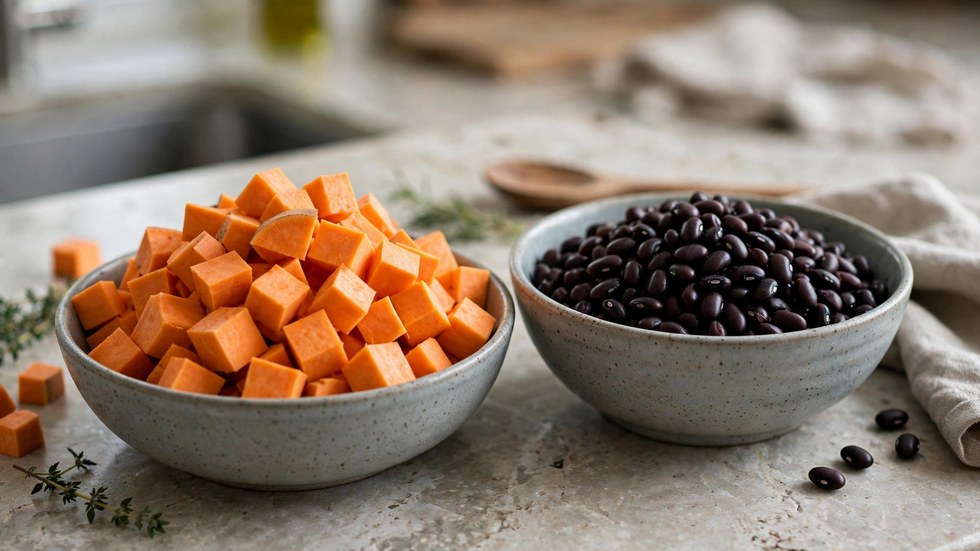
| Sweet potatoes | 1 kg (about 3 medium), cubed | $2.50 |
| Crushed tomatoes | 1 × 796 mL can | $1.75 |
| Yellow onion, diced | 1 large | $0.75 |
| Garlic, minced | 4 cloves | $0.30 |
| Vegetable broth | 750 mL | $1.50 |
| Smoked paprika | 2 tsp | $0.25 |
| Ground cumin | 2 tsp | $0.20 |
| Dried oregano | 1 tsp | $0.10 |
| Lime juice | 2 tbsp | $0.50 |
| Salt and black pepper | to taste | $0.10 |
| Total | 8–10 servings | ≈ $11.70 |
That is roughly $1.17 to $1.46 per serving. Toppings — a spoonful of yogurt, some coriander, a squeeze of lime — add a few cents each and are worth it, but even fully dressed this stew stays under $2 a bowl.
Canadian Meal Prep & Macro Estimator
Enter your costs in $ CAD and get per-portion cost, macros and freezer guidance.
How to Make It: Step by Step
- Prep the vegetables. Peel the sweet potatoes and cut them into 2 cm cubes — uniform pieces cook evenly. Dice the onion and mince the garlic. Drain and rinse the black beans; rinsing washes away a good portion of the canning sodium and the starchy liquid that can make the stew gummy.
- Bloom the spices (optional, 2 minutes). If you have the energy, warm a teaspoon of oil in a small pan and toast the smoked paprika, cumin, and oregano for 30 seconds until fragrant, then scrape them into the slow cooker. This deepens the flavour noticeably. If you do not have the energy, just add the spices directly — the long cook still does plenty.
- Load the slow cooker. Add the sweet potato cubes, drained beans, diced onion, garlic, crushed tomatoes, vegetable broth, and spices to the cooker. Stir to combine. The liquid should just about cover the solids; add a splash more broth if needed.
- Cook low and slow. Cover and cook on LOW for 7 to 8 hours or on HIGH for 4 hours, until the sweet potatoes are completely tender when pierced with a fork.
- Thicken and finish. Mash about a cup of the stew directly in the cooker with a potato masher or the back of a spoon — this releases starch from the sweet potatoes and beans and gives the broth body without any added thickener. Stir in the lime juice and season boldly with salt and pepper. Taste: it should be smoky, tangy, and well salted.
Food-Safety Notes
An important note on dried beans, if you use the variation below: kidney beans and some other dried beans contain lectins that require a full boil to neutralize — slow cookers alone may not get hot enough. Black beans are lower risk, but the standard guidance is to boil soaked dried beans hard for 10 minutes before adding them to the slow cooker. Canned beans are fully cooked and safe to add directly. Cool the finished stew within two hours, refrigerate up to 4 days, and freeze for up to 3 months. Thaw in the fridge overnight and reheat until steaming hot throughout.
Serving Ideas Across the Week
The base stew is the starting point, not the whole meal. Over rice, it is a complete dinner. Scooped into tortillas with shredded cabbage, it becomes burritos. Thinned with a little extra broth, it is a soup. Ladled over a baked potato with a dollop of yogurt, it is the kind of comfort food that makes winter bearable.
Toppings transform each bowl: a squeeze of lime, chopped coriander, diced avocado when it is on sale, a spoonful of plain yogurt or sour cream, pickled red onions if you batch those too, or a handful of crushed tortilla chips for crunch. Set out two or three and every lunch feels slightly different.
Dried-Bean Variation (Even Cheaper)
To use dried black beans: soak 450 g (about 2¼ cups) of dried beans in plenty of cold water overnight, then drain. Bring them to a rolling boil in fresh water for 10 minutes, drain again, and add to the slow cooker with all other ingredients. Increase the broth to 1 litre and cook on LOW for 8 to 9 hours. The batch cost drops to roughly $8 total — under a dollar a serving. The texture is arguably better too: dried beans hold their shape while turning creamy inside.
Storage and Freezing
This slow cooker black bean sweet potato stew might be the single best freezer candidate in this collection. The flavours are stable, the texture survives freezing and thawing with minimal change, and it reheats in minutes. Portion into 500 mL containers or freezer bags laid flat, label with the date, and freeze for up to 3 months. In the fridge, the stew keeps 4 days and the flavour improves daily.
One practical tip: freeze some portions without toppings and add fresh lime, coriander, or yogurt after reheating. Bright, fresh garnishes make a thawed stew taste newly cooked.
The Case for the Cheapest Stew in the Rotation
There will be weeks when the grocery budget is tight and the weather is miserable — sometimes both at once. That is when this stew earns its place. Eleven dollars of humble ingredients, a slow cooker doing the work while you do anything else, and ten bowls of smoky, hearty, genuinely delicious food. It is proof that eating well in winter does not require spending well, just planning a little.
If you want to round out the nutrition further, serve each bowl over brown rice or with a chunk of whole-grain bread — both inexpensive and both turning an already filling stew into a meal that genuinely lasts. And if you find yourself making this every other week through January and February, you are in good company. The best winter recipes are the ones you stop thinking of as recipes and start thinking of as habits.


You May Also Like

Slow Cooker Turkey Meatball Casserole: High-Protein Batch Prep
Budget French Onion Soup Batch Cooking for Cold Nights
